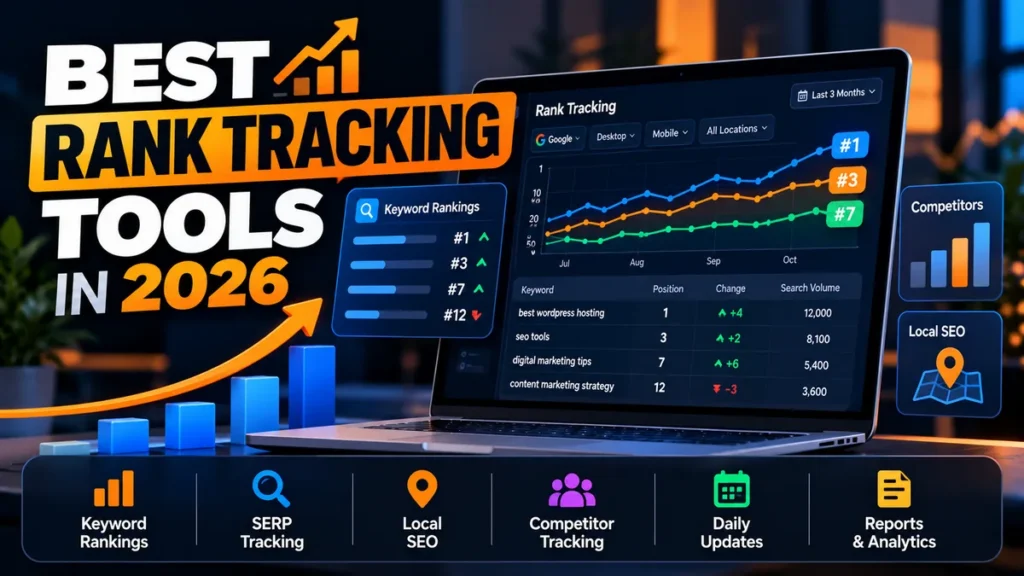
Best Rank Tracking Tools in 2026
The best rank tracking tools tell you more than whether a keyword moved from position eight to position six. A useful tracker helps you understand which pages are gaining visibility, where rankings differ by location and device, how competitors are moving, and whether your SEO work is producing measurable search visibility.
For this 2026 guide, we compared Semrush, Ahrefs, AccuRanker, SE Ranking, Ubersuggest and Mangools SERPWatcher for businesses, bloggers, freelancers, agencies and WordPress website owners.
Our evaluation is based on documented features, product demonstrations, and verified sources. We did not conduct a controlled accuracy benchmark against thousands of live SERPs, so we do not claim that any provider is universally more accurate than every competitor.
Best Rank Tracking Tools: Quick Verdict
Best overall SEO suite with rank tracking: Semrush
Best for combining rankings with SEO research: Ahrefs
Best dedicated professional rank tracker: AccuRanker
Best balanced alternative for agencies and SMBs: SE Ranking
Best budget option: Ubersuggest
Best beginner-friendly SEO bundle: Mangools SERPWatcher
For businesses that need rank tracking alongside keyword research, competitor analysis, backlink analysis and site auditing, Semrush is our overall pick.
If rank tracking itself is the main job and you manage a large keyword portfolio, AccuRanker deserves serious consideration as a specialist platform.
For a solo blogger or small business watching a relatively small keyword set, Ubersuggest or Mangools may offer better value than paying for a professional SEO suite.
Best Rank Tracking Tools Compared
| Tool | Best For | Relevant Starting Price* | Entry Tracking | Update Frequency |
|---|---|---|---|---|
| Semrush | All-in-one professional SEO | $139/mo | 500 keywords | Daily |
| Ahrefs | SEO research + rank tracking | $29 Starter / $129 Lite | 50 Starter / 750 Lite | Plan-dependent tracking |
| AccuRanker | Dedicated professional tracking | $224/mo Professional | Plan configuration dependent | Daily |
| SE Ranking | Agencies and SMBs | Plan/configuration dependent | Plan-dependent | Plan-dependent |
| Ubersuggest | Budget-conscious users | $29/mo or $16/mo annually | 125 keywords/project | Weekly on Individual |
| Mangools | Beginners and freelancers | $37.70/mo annually | 200 keywords | Weekly on Basic |
*Pricing and limits checked October 7, 2026. Subscription pricing, promotions, keyword limits and update frequencies can change. Check the provider’s live pricing page before purchasing.
What Is a Rank Tracking Tool?
A rank tracker monitors where a website or URL appears in search results for selected keywords over time.
Instead of manually searching Google for dozens or hundreds of queries, you create a project, add your target keywords, choose relevant locations and devices, and let the software record ranking changes.
A useful rank tracker can help answer questions such as:
- Which keywords gained or lost positions?
- Which landing pages are becoming more visible?
- Are desktop and mobile rankings different?
- How does visibility differ between countries or cities?
- Are competitors gaining ground?
- Did rankings change after a site update?
- Are SEO campaigns improving visibility over time?
How We Evaluated Rank Tracking Tools
We focused on practical decision-making rather than awarding points for the longest feature list.
Our main criteria included:
- Keyword tracking capacity
- Update frequency
- Desktop and mobile tracking
- Location support
- Competitor monitoring
- Historical ranking data
- SERP-feature visibility
- Reporting and exports
- Google Search Console and analytics integrations where available
- Agency functionality
- Ease of use
- Broader SEO functionality
- Price relative to the intended user
1 Semrush — Best Overall Rank Tracking and SEO Suite
Semrush is our overall recommendation when rank tracking is one part of a broader professional SEO workflow.
Its current SEO plan includes Position Tracking alongside keyword research, competitor analysis and Site Audit.
At our fact check, the standalone SEO plan supports five websites and 500 keywords tracked daily.
That makes Semrush particularly useful for businesses that want to move from “our ranking changed” to “why did it change, what competitors are doing, and what should we work on next?”
Semrush Pricing in 2026
| Plan | Monthly Billing | Annual Equivalent | Tracked Keywords |
|---|---|---|---|
| SEO | $139/mo | $117.33/mo | 500 |
| SEO + AI Search Starter | $199/mo | $165.17/mo | 500 |
| Pro+ | $299/mo | $248.17/mo | 1,500 |
| Advanced | $549/mo | $455.67/mo | 5,000 |
Semrush currently provides mobile ranking data across these plans, while higher tiers expand websites, keyword limits and advanced capabilities.
The Pro+ tier is particularly relevant when multi-location or multi-device tracking is important.
Semrush Pros and Cons
Pros
- Daily keyword tracking
- Strong Position Tracking workflow
- Competitor monitoring
- Mobile data
- Integrates rankings with keyword research
- Site Audit included
- Useful for agencies and marketing teams
- AI-search visibility available within newer packages
Cons
- Expensive if rank tracking is all you need
- Broad platform can take time to learn
- Higher keyword requirements quickly push users toward more expensive tiers
- Some advanced multi-location functionality requires higher plans
Who Should Choose Semrush?
Choose Semrush if you want ranking data connected to a larger SEO workflow involving competitors, keywords, technical SEO and search visibility.
It is particularly suitable for professional marketers, growing businesses and agencies that will use more than Position Tracking alone.
2 Ahrefs — Best for Rank Tracking Plus SEO Research
Ahrefs is another strong choice when ranking data needs to connect with backlink, keyword, competitor and content research.
Its current $29 Starter plan includes Rank Tracker with up to 50 tracked keywords.
The $129 Lite plan increases the allowance to 750 tracked keywords, while Standard currently provides 2,000 and Advanced provides 5,000.
An important 2026 detail is that Rank Tracker operates with its own limits and does not consume the general credits used by Ahrefs’ credit-based Starter and Lite plans.
Ahrefs Pricing
| Plan | Price | Tracked Keywords |
|---|---|---|
| Starter | $29/mo | 50 |
| Lite | $129/mo | 750 |
| Standard | $249/mo | 2,000 |
| Advanced | $449/mo | 5,000 |
Ahrefs also provides historical data allowances that increase with higher plans, making the broader platform useful when ranking movements need to be investigated alongside competitor pages, links and keywords.
Ahrefs Pros and Cons
Pros
- Rank tracking connected to a powerful SEO research suite
- 50-keyword Starter option lowers the entry cost
- 750 tracked keywords on Lite
- Competitor and keyword research
- Backlink analysis
- Historical data on applicable plans
- Rank Tracker does not consume general Ahrefs credits
Cons
- Starter is limited for larger keyword portfolios
- Lite costs $129 per month
- May be excessive if you only need position monitoring
- Different limits across Ahrefs tools require some attention
Who Should Choose Ahrefs?
Ahrefs makes sense for content-led businesses, affiliate publishers, SEO consultants and marketers who want to investigate rankings alongside keywords, competitors and backlinks.
3 AccuRanker — Best Dedicated Professional Rank Tracker
AccuRanker differs from Semrush and Ahrefs because rank tracking is the core product rather than one feature inside a broad SEO suite.
Its Professional plan currently includes daily ranking updates, keyword research, search intent, tagging, advanced filtering, Google Search Console and Google Analytics integrations, reporting and exports.
The higher Expert tier adds functionality including dynamic tagging, AI CTR, AI Search Volume, Looker Studio support and unlimited read API access.
AccuRanker Pricing
At our fact check, Professional started at $224 per month on monthly billing, while Expert started at $764 per month at its displayed configuration.
Annual payment currently receives a 10% discount.
AccuRanker also states that all current plans include unlimited users, which can be important for agencies and larger teams.
New purchases currently have a 14-day refund policy, subject to AccuRanker’s terms.
AccuRanker Pros and Cons
Pros
- Dedicated rank-tracking platform
- Daily updates
- Advanced filtering and tagging
- Google Search Console integration
- Google Analytics integration
- Reporting and exports
- Unlimited users on current plans
- API functionality on applicable tiers
Cons
- Much more expensive than beginner rank trackers
- Overkill for a small blog tracking 50 keywords
- Does not replace a full backlink or technical SEO platform
- Best value appears at professional or agency scale
Who Should Choose AccuRanker?
Choose AccuRanker when rank tracking is a core operational requirement rather than an occasional SEO check.
It is particularly relevant to SEO agencies, consultants and in-house teams managing substantial keyword portfolios across multiple markets.
4 SE Ranking — Best Balanced Alternative for Agencies and SMBs
SE Ranking occupies useful middle ground between basic rank trackers and expensive enterprise-oriented SEO platforms.
Its platform combines rank tracking with broader SEO functions, making it worth considering when you need more than position monitoring but do not necessarily want to pay Semrush or Ahrefs pricing.
SE Ranking is particularly relevant to agencies because its ecosystem includes reporting, project management and client-oriented workflows alongside SEO research.
Pricing and tracking allowances can vary according to plan configuration and billing choices, so we recommend checking the live calculator immediately before purchasing rather than relying on a static price quoted months earlier.
SE Ranking Pros and Cons
Pros
- Rank tracking is a major part of the platform
- Broader SEO toolset
- Useful agency workflows
- Competitor monitoring
- Reporting capabilities
- Flexible positioning between budget and premium suites
Cons
- Pricing depends on current configuration and package
- May still be more software than a casual blogger needs
- Users should compare exact keyword/update limits before subscribing
Who Should Choose SE Ranking?
Consider SE Ranking if you are a freelancer, small agency or growing business looking for a broad SEO platform with rank tracking at its center but want an alternative to Semrush and Ahrefs.
5 Ubersuggest — Best Budget Rank Tracking Tool
Ubersuggest is attractive when you need basic rank tracking but cannot justify spending $100 or more each month on SEO software.
Its current Individual plan supports 125 tracked keywords for one project, mobile rank tracking and up to 20 locations.
The important limitation is update frequency: Individual currently tracks rankings weekly rather than daily.
Ubersuggest Pricing
| Plan | Monthly | Annual Equivalent | Tracked Keywords / Project | Update Cycle |
|---|---|---|---|---|
| Individual | $29 | $16/mo | 125 | Weekly |
| Business | $49 | $27.17/mo | 150 | Weekly |
| Enterprise | $99 | $54.75/mo | 300 | Weekly |
The annual Individual price is currently $192, while Business is $326 and Enterprise is $657.
Ubersuggest also offers lifetime plans. At our fact check these were $290 for Individual, $490 for Business and $990 for Enterprise.
Monthly subscriptions currently have a one-time seven-day free trial. Lifetime purchases are final and non-refundable according to the current pricing FAQ.
Ubersuggest Pros and Cons
Pros
- Low entry price
- 125 tracked keywords on Individual
- Mobile tracking
- Multiple location support
- Keyword research included
- Site auditing included
- Competitor research
- Annual and lifetime purchase options
Cons
- Weekly rather than daily rank updates on current standard plans
- Lower keyword capacity than professional platforms
- Not ideal for intensive agency monitoring
- Lifetime purchases are non-refundable
Who Should Choose Ubersuggest?
Ubersuggest is best for bloggers, freelancers and small businesses that need to monitor a manageable keyword portfolio without paying premium SEO-suite prices.
6 Mangools SERPWatcher — Best Beginner-Friendly SEO Bundle
SERPWatcher is Mangools’ rank-tracking component and is bundled with the company’s wider SEO toolkit.
The current Basic package supports 200 tracked keywords across unlimited domains, although rankings update weekly.
Premium increases the allowance to 700 tracked keywords but also currently uses weekly updates.
Agency increases the allowance to 1,500 tracked keywords and provides daily ranking updates.
Mangools Pricing
| Plan | Annual-Billing Equivalent | Tracked Keywords | Rank Update Frequency |
|---|---|---|---|
| Basic | $37.70/mo | 200 | Weekly |
| Premium | $52.70/mo | 700 | Weekly |
| Agency | $97.70/mo | 1,500 | Daily |
Mangools currently advertises a 48-hour money-back guarantee, subject to its terms.
Mangools Pros and Cons
Pros
- Beginner-friendly SEO ecosystem
- 200 tracked keywords on Basic
- Unlimited domains for tracking on current plans
- Keyword research included
- SERP analysis included
- Backlink and site-analysis tools included
- Agency tier provides daily updates
Cons
- Basic and Premium currently update rankings weekly
- Daily tracking requires Agency
- Less appropriate for sophisticated enterprise workflows
- Users wanting only a rank tracker may not need the entire bundle
Who Should Choose Mangools?
Mangools makes sense for bloggers, freelancers and smaller marketing teams that value a simpler interface and want keyword research, SERP analysis and rank tracking in one approachable toolkit.
Which Rank Tracker Offers the Best Value?
Value depends heavily on how many keywords you need to track and how frequently you need fresh positions.
Small website with weekly monitoring: Ubersuggest offers one of the lowest-cost practical starting points.
Beginner needing broader SEO tools: Mangools is easy to consider.
Business needing daily tracking plus full SEO tools: Semrush offers a stronger professional workflow.
Content/SEO professional already needing backlink research: Ahrefs can consolidate several SEO jobs into one subscription.
Agency where rank tracking is mission-critical: AccuRanker becomes much easier to justify.
Daily vs Weekly Rank Tracking: Does It Matter?
Daily tracking is useful when SEO performance needs close monitoring.
It can help agencies document client movement, monitor major site migrations, investigate algorithm volatility or follow commercially important keywords.
But daily updates are not necessary for every website.
A small business publishing several articles per month may get enough decision-making value from weekly tracking.
Paying substantially more for daily updates only makes sense if the extra frequency changes what you do.
Best Rank Tracking Tool for Small Businesses
For a small business with a limited SEO budget, Ubersuggest is a sensible starting point.
Its Individual plan currently tracks 125 keywords for one project and includes other SEO functions.
If SEO generates meaningful leads or revenue and you need daily monitoring, moving to Semrush or another professional tracker can be justified.
Best Rank Tracking Tool for Bloggers
Bloggers should avoid paying for thousands of tracked keywords before their site needs them.
Ubersuggest, Mangools and Ahrefs Starter are all worth comparing for smaller keyword portfolios.
Ahrefs becomes especially compelling when backlink research and competitor content analysis are also important to your publishing workflow.
Best Rank Tracking Tool for Agencies
Agencies need more than a ranking chart.
Useful agency features include:
- Multiple projects
- Large keyword allowances
- Location and device segmentation
- Competitor tracking
- Reporting
- Data exports
- Team access
- API or Looker Studio integration at scale
For those workflows, AccuRanker is our specialist choice, while Semrush is preferable when the agency wants a broader SEO platform.
Best Rank Tracking Tool for Local SEO
Local SEO tracking requires more precision than simply selecting a country.
A company serving a specific city should verify whether its chosen tracker supports the locations, devices and search environments that matter to its customers.
For multi-location campaigns, compare Semrush, AccuRanker and SE Ranking carefully based on the exact geographic granularity you need.
Remember that traditional organic rank tracking and Google Maps/local-pack grid tracking are different use cases. Businesses heavily dependent on map visibility may need a dedicated local-grid tracking product in addition to a conventional rank tracker.
Best Rank Tracking Tools for GCC Businesses
Businesses operating in Saudi Arabia, UAE and the wider GCC should not assume that a rank tracker configured for the United States accurately represents regional search visibility.
Track the market where your customers actually search.
For example, a Riyadh business may need Saudi-specific desktop and mobile tracking, while a GCC ecommerce company could require separate projects or locations for Saudi Arabia, UAE, Qatar, Kuwait, Bahrain and Oman.
Arabic and English keywords may also represent different search intents, so they should be tracked as distinct keyword sets rather than treated as direct translations of the same campaign.
Before subscribing, verify:
- Saudi and UAE location availability
- City-level tracking where required
- Desktop and mobile support
- Google country/language settings
- Arabic keyword handling
- Competitor tracking limits
- VAT and billing treatment
- Export/reporting requirements
How to Choose a Rank Tracking Tool
1. Calculate How Many Keywords You Actually Need
Do not count only your current top keywords.
Include important service pages, product categories, commercial queries, content clusters and local variations.
Then add room for future growth.
2. Decide Whether You Need Daily Tracking
Weekly updates can be perfectly adequate for smaller websites.
Agencies, ecommerce businesses and aggressive SEO campaigns may benefit more from daily monitoring.
3. Check Location and Device Requirements
A keyword can perform differently on mobile and desktop and across geographic locations.
Make sure your subscription supports the markets that actually generate revenue.
4. Decide Whether You Need a Rank Tracker or an SEO Suite
If you already pay separately for keyword research, backlinks and technical audits, a dedicated tracker may be appropriate.
If you need all of those functions, an integrated platform such as Semrush or Ahrefs may reduce software fragmentation.
5. Consider Reporting
A solo blogger may only need an online dashboard.
An agency may need scheduled reporting, exports, integrations and team access.
6. Compare Cost per Useful Keyword, Not Just Subscription Price
A $30 tool is not automatically cheaper if its limits force you to exclude commercially important keywords.
Likewise, a $200 professional platform is poor value if you only track 40 terms once a week.
Rank Tracking Mistakes to Avoid
- Tracking hundreds of irrelevant keywords
- Focusing only on exact positions instead of visibility trends
- Ignoring mobile rankings
- Tracking the wrong country or city
- Comparing tools configured with different locations
- Reacting to every one-position daily movement
- Ignoring the landing page that ranks
- Tracking keywords without connecting them to leads, sales or business goals
Best Rank Tracking Tools by User Type
| User Type | Recommended Tool | Why |
|---|---|---|
| Small business | Ubersuggest | Affordable tracking plus broader SEO tools |
| Professional marketer | Semrush | Daily tracking integrated with a full SEO workflow |
| Content publisher | Ahrefs | Rankings plus content, keyword and backlink research |
| SEO agency | AccuRanker | Dedicated professional rank monitoring |
| Growing small agency | SE Ranking | Balanced SEO and agency-oriented workflow |
| Beginner | Mangools | Approachable SEO bundle |
| Budget blogger | Ubersuggest | Low-cost entry point |
| Large keyword portfolio | AccuRanker | Purpose-built rank tracking at scale |
| GCC marketing team | Semrush / AccuRanker | Better fit for professional multi-market monitoring |
Alternatives Worth Considering
Google Search Console
Search Console should be used alongside a rank tracker rather than treated as a direct replacement.
It provides valuable first-party Google performance data including queries, pages, impressions, clicks and average position, but it serves a different purpose from fixed-keyword daily SERP monitoring.
Google Analytics
Analytics does not track organic keyword positions, but it helps answer the more important business question: what happens after organic visitors reach your website?
Combine ranking trends with traffic and conversion data instead of judging SEO success entirely by SERP positions.
Dedicated Local Rank Trackers
Businesses where Google Maps visibility is critical should consider specialized local-grid tracking software in addition to conventional organic rank tracking.
Best Rank Tracking Tools: Final Verdict
For most professional marketers looking for the best rank tracking tools in 2026, Semrush is our overall recommendation because its Position Tracking functionality sits inside a much broader SEO environment.
Choose Ahrefs when rankings need to connect closely with backlink, keyword and competitor research.
Choose AccuRanker when rank tracking itself is a core professional or agency requirement and you are willing to pay for a specialist platform.
Consider SE Ranking if you want an agency-friendly alternative positioned between budget tools and the largest SEO suites.
Choose Ubersuggest when price matters more than daily updates.
Choose Mangools SERPWatcher when you prefer a simpler SEO toolkit and your tracking requirements fit its current update schedule and keyword limits.
Our Final Picks
Best overall: Semrush
Best for SEO research + tracking: Ahrefs
Best dedicated rank tracker: AccuRanker
Best balanced agency alternative: SE Ranking
Best budget option: Ubersuggest
Best beginner-friendly bundle: Mangools SERPWatcher
Frequently Asked Questions
What is the best rank tracking tool in 2026?
Semrush is our overall recommendation for businesses and professional marketers because it combines daily Position Tracking with keyword research, competitor analysis and technical SEO tools. AccuRanker is a stronger specialist choice when rank monitoring itself is the primary requirement.
What is the best cheap rank tracker?
Ubersuggest is one of the most accessible paid options in this comparison. Its Individual plan currently costs $29 monthly or $16 per month when billed annually and supports 125 tracked keywords for one project.
Does Google Search Console track keyword rankings?
Google Search Console reports search-performance data including queries, impressions, clicks and average position. It is extremely useful, but it does not replace a conventional fixed-keyword rank tracker configured to monitor specific keywords, competitors, locations and devices on a schedule.
How often should I check keyword rankings?
Weekly monitoring is sufficient for many bloggers and small businesses. Daily tracking becomes more useful for agencies, large SEO campaigns, migrations, ecommerce sites and commercially important keyword portfolios where faster visibility into changes affects decisions.
Is Semrush good for rank tracking?
Yes. Semrush’s current SEO plan includes Position Tracking and 500 keywords tracked daily across five monitored websites. Higher plans increase tracking limits and add more advanced functionality.
Does Ahrefs have a rank tracker?
Yes. Ahrefs Starter currently includes 50 Rank Tracker keywords, Lite includes 750, Standard includes 2,000 and Advanced includes 5,000. Rank Tracker uses its own limits rather than consuming the general credits used by credit-based Ahrefs plans.
What is the best rank tracker for agencies?
AccuRanker is our dedicated specialist choice for agencies, while Semrush is better when the agency also needs a broad SEO research platform. SE Ranking is another option worth comparing for agencies looking for a balance of tracking, SEO tools and reporting.
Should I track rankings on mobile and desktop?
Yes when both device types matter to your audience. Search results can differ between mobile and desktop, so tracking only one device can hide changes that affect part of your organic audience.