How to Use AI for Restaurant Marketing in 2026: A Practical Growth System
AI can help a restaurant create content faster, analyze marketing information, develop promotions, improve local visibility and organize campaigns—but only when it is given accurate business context and paired with human judgment.
The useful question in 2026 is no longer simply, “Can AI write an Instagram caption?” It can. The more important question is: how can a restaurant turn AI into a repeatable marketing system that supports awareness, visits, orders, reservations and customer retention?
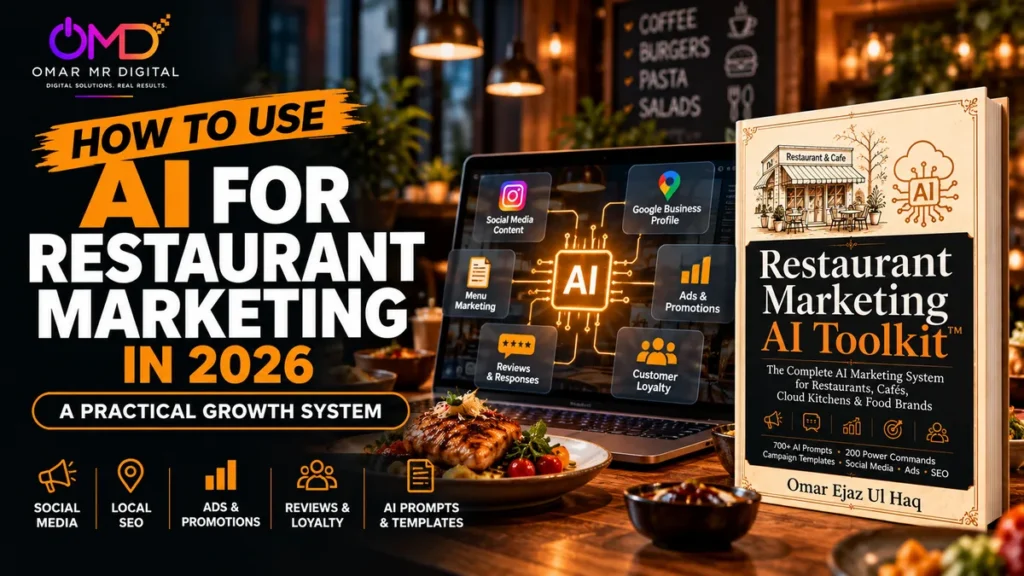
This guide is based on the practical framework developed in Restaurant Marketing AI Toolkit™ by Omar Ejaz Ul Haq. The toolkit is built for restaurants, cafés, cloud kitchens, bakeries, food trucks and food brands, and its central idea is simple: AI becomes much more useful when it understands the business before it is asked to produce marketing.
Table of Contents
- What AI can do
- Build the AI foundation
- Write better prompts
- Brand and customer strategy
- Social media content
- Food photography and creative
- Promotions and offers
- Menu engineering
- Google and local marketing
- Meta and Google Ads
- Reviews and retention
- AI marketing analysis
- 30-day workflow
- Restaurant Marketing AI Toolkit™
- FAQ
What Can AI Actually Do for Restaurant Marketing?
For a restaurant, AI is most useful as a fast first-draft, research, planning and analysis assistant. It can help turn business information into marketing ideas without requiring the owner or manager to begin every task from a blank page.
Practical applications include marketing strategy, social media planning, promotional campaigns, advertising copy, menu descriptions, customer personas, competitor research, review responses, email and WhatsApp campaigns, website content, local-search content, influencer outreach, short-video scripts, photography concepts and marketing reports.
The value is not merely speed. A structured AI workflow lets a restaurant generate an idea, refine it for the target customer, create channel-specific versions, test it, review performance and improve the next campaign.
Restaurant data → Clear objective → Structured AI prompt → Human review → Publish → Measure → Improve
1. Give AI a Restaurant Marketing Foundation
Generic prompts produce generic marketing. Before asking AI to create a campaign, build a reusable restaurant profile containing the information that should remain consistent across your marketing.
Restaurant AI Profile
- Restaurant: name, location and business type
- Cuisine: core food category and signature dishes
- Audience: primary and secondary customer groups
- Positioning: what makes the restaurant meaningfully different
- Brand voice: premium, playful, traditional, family-friendly, bold, etc.
- Price level: typical product and average-order range
- Objectives: awareness, footfall, delivery, reservations, AOV or retention
- Channels: Instagram, TikTok, Facebook, Google, website, WhatsApp and others
- Constraints: budget, capacity, delivery radius, opening hours and campaign dates
This context prevents the AI from having to guess basic facts every time. It also helps different pieces of content sound as though they belong to the same restaurant.
2. Stop Using One-Line Restaurant Prompts
“Write a restaurant post” gives AI almost nothing to work with. A useful prompt should normally specify a role, restaurant context, audience, goal, offer or product, constraints, tone, CTA and required output.
A practical restaurant prompt formula
For example:
Act as a restaurant social-media strategist. Create five Instagram captions for a casual dining restaurant in Riyadh promoting a new spicy chicken burger priced at SAR 29. Target adults aged 18–35. Use a bold, playful voice. Keep each caption under 80 words, avoid unsupported claims, and finish with a clear dine-in or order CTA.
That prompt is more useful because the AI knows what it is marketing, to whom, why, where and under what constraints.
3. Use AI to Clarify Your Brand and Customer
A restaurant brand is more than a logo. Customers form an impression from the food, service, atmosphere, pricing, photography, language and overall experience.
AI can help organize a brand foundation around seven practical questions:
| Element | Question to Answer |
|---|---|
| Audience | Who are the customers we most want to attract? |
| Positioning | How should customers perceive us? |
| Promise | What should customers consistently expect? |
| Personality | If the restaurant were a person, what would it feel like? |
| Voice | How should the brand communicate? |
| Differentiation | Why should someone choose us instead of alternatives? |
| Experience | How should customers feel before, during and after a visit? |
AI can also help create customer personas based on known information such as location, daypart, order behavior, occasion and price sensitivity. Treat these as working hypotheses until real customer and transaction data validates them.
4. Build a Restaurant Social Media System
Restaurants have a natural advantage on visual platforms: the product itself can become content. The mistake is posting only polished food photos with “Visit us today” underneath every image.
A stronger content mix can include:
- Product desire: signature dishes, close-ups, preparation and new items
- Proof: genuine customer experiences, reviews and real restaurant activity
- People: chef, team and behind-the-scenes stories
- Education: ingredients, preparation, cuisine and menu guidance
- Offers: real promotions with clear terms
- Local relevance: neighborhood, occasions and community
- Entertainment: short-form concepts suited to the brand
AI can turn one campaign idea into an Instagram caption, Reel script, TikTok hook, Facebook version and Google Business Profile update. But each version should be adapted to the platform rather than copied blindly.
5. Use AI for Food Photography Concepts—Without Misrepresenting the Food
AI is useful for mood boards, shot lists, background concepts, prop ideas, lighting directions and creative briefs. It can help a restaurant decide how a real dish should be photographed before the shoot begins.
The safest marketing principle is simple: the advertised product should remain recognizable and truthful. Do not generate a spectacular fictional burger, dessert or portion and present it as the food customers will actually receive.
AI-generated or edited advertising assets can also be subject to platform and local disclosure requirements. Google, for example, introduced AI-label options for certain advertising assets in 2026 while noting that advertisers remain responsible for complying with applicable laws.
6. Engineer Offers Instead of Automatically Discounting
A promotion should solve a business problem. “20% off everything” may generate activity, but it can also reduce margin without changing customer behavior in a useful way.
Give AI a specific commercial objective. For example:
- increase Tuesday dinner traffic;
- increase average order value;
- introduce a new menu item;
- convert first-time customers;
- reactivate inactive customers;
- increase family orders;
- drive direct orders during a slow daypart.
Then ask it to develop several offer mechanisms—bundles, add-ons, limited menus, occasion-based packages or loyalty incentives—and evaluate each against margin, capacity and operational complexity.
7. Use AI for Menu Engineering and Product Communication
AI can help organize menu information, improve descriptions, identify confusing naming, develop category structures and generate ideas for promoting priority products.
But AI does not know your true food cost, contribution margin, sales mix or operational difficulty unless you provide those numbers. Menu decisions should therefore combine AI analysis with verified restaurant data.
Sales data + food cost + contribution + customer demand + operational reality → AI-assisted analysis → management decision
8. Use AI for Google Business Profile and Local Marketing
Local visibility matters because restaurant searches often carry immediate intent. AI can help draft Business Profile updates, restaurant descriptions, Q&A ideas, local landing-page outlines and responses to customer feedback.
Google currently allows businesses to publish Business Profile updates with text, photos or videos, including announcements, offers and events. Google also advises businesses to avoid low-value, distracting or auto-generated content and to keep information relevant and professional.
That means AI should support the process—not flood the profile with repetitive posts.
- Verify address, hours and service information.
- Use real menu and offer details.
- Keep location references natural.
- Use genuine restaurant imagery where product accuracy matters.
- Respond to reviews individually rather than pasting the same AI response.
- Never invent awards, ratings, popularity or scarcity.
Google explicitly prohibits fake engagement and incentivized or manipulated reviews. A restaurant may encourage genuine reviews, but should not pay customers or offer discounts in exchange for favorable ratings.
9. Use AI to Build Better Meta and Google Ad Inputs
AI can accelerate ad ideation by producing hook variations, primary-copy angles, headline options, audience hypotheses, visual briefs and landing-page messages.
Before generating ads, provide the commercial facts:
- hero product;
- verified price;
- real offer terms;
- location or delivery area;
- campaign dates;
- customer segment;
- objective;
- budget;
- capacity constraints;
- conversion action.
A useful restaurant ad should answer three questions quickly: What is it? Why should I care? What should I do next?
Do not let AI invent “#1 restaurant,” “best in Riyadh,” “only five left,” customer testimonials or other proof that the business cannot substantiate.
10. Use AI for Review Management, Loyalty and Direct Marketing
Review responses are a good example of where AI can save time without replacing human judgment. AI can draft a respectful response, but staff should verify what happened and personalize the final message—especially when the customer reports a service or food-quality problem.
AI can also help plan loyalty communications and direct campaigns for opted-in customers: welcome messages, win-back ideas, birthday campaigns, new-menu announcements and customer-segment offers.
The objective is not to send more messages. It is to send more relevant messages.
11. Make AI Analyze Marketing—Not Just Create It
One of the most underused applications of AI is analysis. Feed it clean, non-sensitive campaign data and ask it to identify patterns, anomalies and questions management should investigate.
The Restaurant Marketing AI Toolkit™ organizes restaurant metrics into a hierarchy: business outcomes, customer outcomes, conversion, channel performance, and attention or engagement.
| Level | Examples | Management Question |
|---|---|---|
| Business outcomes | Revenue, contribution, transactions, AOV | Did marketing contribute to business performance? |
| Customer outcomes | New customers, repeat customers, retention | Are we acquiring and keeping valuable customers? |
| Conversion | Orders, reservations, leads, CPA | Is attention becoming action? |
| Channel performance | Paid clicks, organic traffic, Google interactions | Which channels deserve more or less investment? |
| Attention | Reach, views, engagement | Are people noticing and interacting with the content? |
A dashboard should change a decision. If a metric looks impressive but never affects what the restaurant does next, it probably should not dominate management reporting.
12. A Simple 30-Day AI Restaurant Marketing Workflow
Week 1 — Foundation
Document the restaurant profile, audience, positioning, brand voice, hero products, offers, slow periods and current marketing performance. Audit the website, social profiles and Google Business Profile.
Week 2 — Reach
Create a coordinated content calendar. Produce social content, short-video concepts, Google updates and local-search content around the same restaurant priorities.
Week 3 — Conversion
Launch or refine a real offer, improve calls to action, test advertising creative and make priority menu items easier to understand and buy.
Week 4 — Retention and Optimization
Review performance, respond to customer feedback, create a retention or reactivation campaign, identify the strongest content and offers, and build the next month from evidence.
Turn These Ideas Into a Complete Restaurant AI Marketing System
The Complete AI Marketing System for Restaurants, Cafés, Cloud Kitchens & Food Brands
By Omar Ejaz Ul Haq
This article covers the framework. The full Restaurant Marketing AI Toolkit™ is designed for implementation.
It expands the system across restaurant branding, customer personas, competitor intelligence, Instagram, Facebook, TikTok, viral hooks, food-photography prompts, advertising creative, promotions, offer engineering, menu engineering, Google Business Profile, website SEO, Meta Ads, Google Ads, reviews, loyalty, WhatsApp/SMS, launches, seasonal campaigns, influencers, partnerships and marketing analysis.
The ebook also contains 200 restaurant marketing AI commands, 700+ restaurant marketing AI prompts, ready-to-use marketing templates, AI workflows, a 30-day marketing calendar, a 100+ point marketing audit, KPI dashboard framework, advertisement templates and a Restaurant AI Master Prompt.
Who it is for: restaurant owners, café operators, cloud-kitchen teams, food brands, in-house marketers, freelancers and agencies working with hospitality clients.
Publishing note: Add the final Kindle product URL to the button below once the Amazon listing is live.
Get Restaurant Marketing AI Toolkit™ on Kindle →What AI Should Never Be Allowed to Invent
The more AI becomes part of daily restaurant marketing, the more important verification becomes. Before publishing, check every factual statement that could affect a customer’s decision.
- prices and discounts;
- promotion dates and terms;
- opening hours;
- ingredients and allergens;
- delivery areas;
- menu availability;
- reservation availability;
- customer quotes and reviews;
- awards and rankings;
- “best seller” or popularity claims;
- scarcity;
- nutrition or health claims.
AI can generate persuasive language in seconds. That makes the human review stage more—not less—important.
Final Thoughts
Restaurant marketing does not improve because a business suddenly has access to hundreds of AI tools. It improves when the restaurant has a clear strategy and uses AI to execute that strategy faster and more consistently.
Start with the restaurant, not the technology. Define the customer. Clarify the brand. Identify the business problem. Give AI accurate context. Create. Verify. Publish. Measure. Then feed the learning back into the next campaign.
That is how AI moves from a caption generator to a practical restaurant marketing system.
Frequently Asked Questions
How can restaurants use AI for marketing?
Restaurants can use AI to support strategy, social-media planning, captions, short-video scripts, promotions, menu descriptions, local SEO, ad creative, review-response drafts, loyalty campaigns and marketing analysis. Outputs should always be reviewed against real business information before publication.
Can AI create a complete restaurant marketing plan?
AI can help structure a plan when it receives accurate information about the restaurant, audience, objectives, budget, menu, capacity, channels and performance. Management still needs to validate assumptions, choose priorities and approve execution.
Can restaurants use AI-generated food images?
AI can be useful for concepts and creative production, but restaurants should avoid presenting a fictional or materially altered product as though it is the meal customers will receive. Advertising and disclosure requirements can also vary by platform and jurisdiction.
Can AI help with Google Business Profile?
Yes. AI can help draft updates, descriptions, Q&A ideas and review responses. Google advises businesses to keep Business Profile content relevant and professional and to avoid low-value auto-generated content. All business information should be verified before publishing.
What is Restaurant Marketing AI Toolkit™?
It is a practical ebook by Omar Ejaz Ul Haq for restaurants, cafés, cloud kitchens and food brands. It combines restaurant marketing strategy with reusable AI prompts, commands, templates, workflows, campaign systems, a marketing audit, KPI framework and implementation plans.
Fact checked: September 26, 2026. Platform features, advertising policies and AI requirements can change. Verify current rules with the relevant platform before publishing campaigns or relying on AI-generated marketing assets.