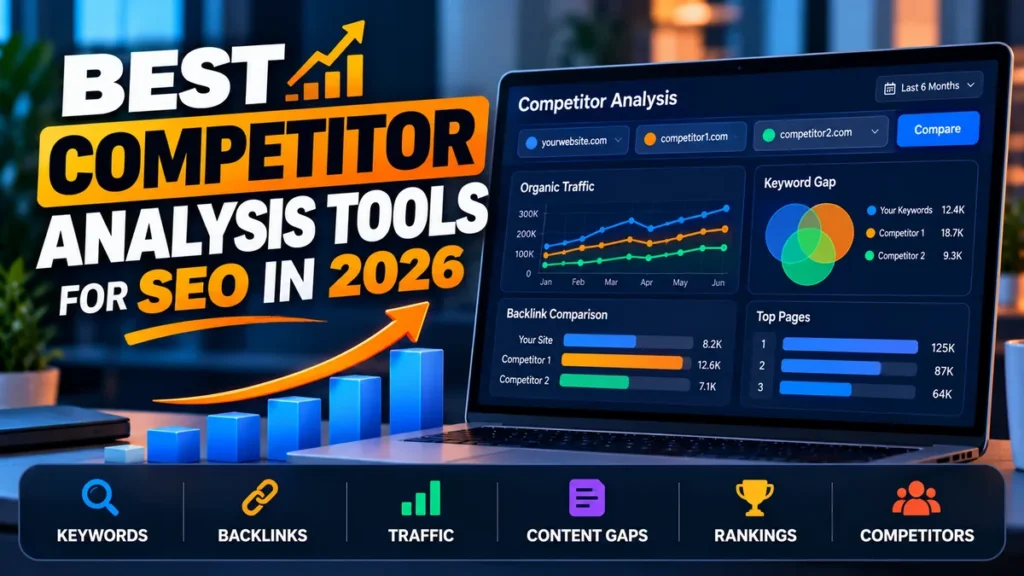
Best Competitor Analysis Tools for SEO in 2026
Your competitors can reveal some of the most useful SEO opportunities you have not found yet: keywords they rank for, pages attracting organic traffic, backlinks supporting their authority, paid search activity, content gaps and emerging visibility in AI-powered search.
The challenge is choosing the right software. Some competitor analysis tools are built primarily for SEO. Others focus on backlinks, traffic intelligence, market benchmarking or lower-cost competitive research.
For this guide to the best competitor analysis tools, we compared Semrush, Ahrefs, SE Ranking, Similarweb and Ubersuggest for small businesses, freelancers, content publishers, agencies and WordPress users.
Our assessment is based on documented features, product demonstrations, and verified sources. We did not perform a controlled accuracy benchmark between proprietary traffic, keyword or backlink databases, so estimated metrics should be treated as directional competitive intelligence rather than first-party analytics.
Best Competitor Analysis Tools: Quick Verdict
Best overall for SEO competitor analysis: Semrush
Best for backlinks and organic competitor research: Ahrefs
Best balanced alternative for SMBs and agencies: SE Ranking
Best for market and website traffic intelligence: Similarweb
Best budget option: Ubersuggest
Semrush is our overall recommendation when your goal is to turn competitor research into an SEO action plan. Its SEO Toolkit combines organic competitor discovery, keyword-gap research, backlinks, rankings and site analysis.
Ahrefs is especially compelling when competitor backlinks, top-performing pages and content gaps are central to your workflow.
For broader questions such as where competitor traffic comes from, how audiences behave and how companies compare across marketing channels, Similarweb approaches competitive research from a different angle.
Best SEO Competitor Analysis Tools Compared
| Tool | Best For | Relevant Starting Price* | Key Competitive Strength |
|---|---|---|---|
| Semrush | Overall SEO competitor research | $139.95/mo SEO Pro | Organic keywords, gaps, backlinks and search competitors |
| Ahrefs | SEO, backlinks and content gaps | $129/mo Lite | Site Explorer, organic competitors and link research |
| SE Ranking | SMBs and agencies | $129/mo Core | Competitive Research plus broad SEO workflow |
| Similarweb | Traffic and market intelligence | $199/mo or $125/mo annually | Traffic, channels, audience and market benchmarking |
| Ubersuggest | Budget competitor research | $29/mo | Accessible keyword and competitor research |
*Pricing checked October 7, 2026. Pricing, limits, promotions and packaging can change. Verify the provider’s live checkout before purchasing.
What Is an SEO Competitor Analysis Tool?
An SEO competitor analysis tool helps you investigate how other websites acquire visibility in search and where your own website may be missing opportunities.
Depending on the platform, you can investigate:
- Organic competitors
- Competitor keywords
- Keyword gaps
- Top-performing pages
- Backlink profiles
- Referring domains
- Paid keywords and advertisements
- Ranking changes
- Estimated organic traffic
- Estimated overall website traffic
- Traffic channels
- Content gaps
- SERP competitors
- AI-search visibility
The best tool is therefore determined by the competitive question you are trying to answer.
How We Evaluated the Best Competitor Analysis Tools
We focused on whether each platform can help a marketer move from competitor data to an actionable SEO decision.
Our main criteria included:
- Organic competitor discovery
- Competitor keyword research
- Keyword-gap analysis
- Top-page analysis
- Backlink competitor research
- Historical data
- Paid-search visibility
- Traffic and market intelligence
- Rank tracking
- AI-search competitive insights
- Reporting and export capabilities
- Ease of use
- Pricing and value
- Suitability for SMBs, publishers and agencies
1 Semrush — Best Overall Competitor Analysis Tool for SEO
Semrush is our overall pick because competitor analysis is spread across several useful SEO workflows rather than being limited to a single report.
Its Organic Rankings reports can identify websites competing for the same organic search visibility, show their ranking keywords and pages, surface ranking changes and analyze SERP-feature visibility.
Keyword Gap lets you compare keyword portfolios across competing websites to find queries where competitors rank and your site does not.
Backlink-focused tools provide another competitive layer, while Position Tracking helps monitor selected competitors around a defined keyword set.
Semrush Organic Competitor Research
A useful starting point is the Organic Rankings Competitors report.
Instead of assuming that your offline business rivals are also your search competitors, Semrush identifies domains competing around overlapping organic keywords.
That distinction matters.
A local retailer, SaaS company or affiliate publisher can face websites in Google that the business team would never have identified as traditional competitors.
Semrush Keyword Gap
Keyword Gap can compare keyword portfolios across multiple competing domains.
This is useful for finding:
- Topics competitors cover but you do not
- Keywords where competitors outperform you
- Commercial search opportunities
- Content-cluster gaps
- Organic and paid-search overlap
Semrush Pricing in 2026
Semrush’s current SEO Toolkit pricing is:
| SEO Toolkit Plan | Monthly Price | Main Limits |
|---|---|---|
| Pro | $139.95/mo | 5 monitored websites, 500 tracked keywords, 10,000 results/report |
| Guru | $249.95/mo | 15 websites, 1,500 keywords, historical data, 30,000 results/report |
| Business | $499.95/mo | 40 websites, 5,000 keywords, API access, 50,000 results/report |
The Pro tier includes Organic Rankings competitor research, but historical Organic Rankings data requires Guru or Business.
Do You Need Semrush Traffic & Market Too?
Not necessarily.
For SEO-focused competitive research, the SEO Toolkit is the more relevant starting point.
Semrush now sells its broader Traffic & Market intelligence separately. The current Pro plan costs $289 per month and includes full real-domain analysis, traffic-channel intelligence, audience insights, market analysis and competitor monitoring.
That makes it useful for teams asking broader strategic questions, but it can substantially increase your total software cost.
Semrush Pros and Cons
Pros
- Strong organic competitor discovery
- Keyword Gap analysis
- Competitor ranking research
- Backlink research
- Paid-search research
- Rank tracking
- Site Audit included
- AI-search capabilities increasingly integrated
- Historical competitive data on higher plans
Cons
- Premium pricing
- Broad platform takes time to learn
- Historical data requires a higher SEO tier
- Traffic & Market is a separate paid toolkit
- Can be excessive for one small website
Who Should Choose Semrush?
Choose Semrush if competitor research is part of a wider professional SEO process involving keywords, rankings, backlinks, technical SEO and content planning.
It is particularly suitable for marketers, agencies and growing businesses that will use several parts of the platform rather than buying it for one report.
2 Ahrefs — Best for Backlinks and Organic Competitor Research
Ahrefs is one of the strongest alternatives when you want to understand how competing websites generate organic visibility and links.
Site Explorer currently combines organic and AI-search performance, backlink analysis and paid-search research around competing domains.
Its Organic Competitors report can identify competing sites based on keyword overlap and compare their organic traffic, traffic value and ranking-page footprint.
Find Competitor Content Gaps
Ahrefs’ Competitive Analysis workflow includes Content Gap.
You can currently compare your target against up to 10 competitor URLs and identify keywords competitors rank for while your site does not.
That is useful when building a content roadmap because it converts competitor research into specific topics rather than a generic list of competing websites.
Analyze Competitor Backlinks
Backlink research remains one of the strongest reasons to consider Ahrefs.
You can investigate competitor referring domains, backlink changes and highly linked pages, then use that information to identify realistic link-building opportunities.
Ahrefs Pricing in 2026
| Plan | Monthly Price | Best Fit |
|---|---|---|
| Lite | $129/mo | Small businesses and personal projects |
| Standard | $249/mo | Freelance SEOs and consultants |
| Advanced | $449/mo | In-house marketing teams |
| Enterprise | $1,499/mo | Large organizations |
Ahrefs currently advertises savings of up to 17% when paying annually.
Ahrefs Pros and Cons
Pros
- Excellent organic competitor research
- Strong backlink analysis
- Content Gap
- Top-page research
- Organic competitor maps
- Paid-search competitor data
- Historical competitive analysis on applicable plans
- Broader SEO toolkit included
Cons
- Lite starts at $129 per month
- Higher tiers become expensive quickly
- Different usage and feature limits require attention
- Overkill for occasional competitor checks
Who Should Choose Ahrefs?
Ahrefs is particularly well suited to content publishers, affiliate sites, SEO professionals and businesses where competitor content and backlink research are major parts of the growth strategy.
3 SE Ranking — Best Balanced Alternative for SMBs and Agencies
SE Ranking is increasingly positioned as a broad SEO and AI-search platform rather than simply a lower-cost rank tracker.
Its Competitive Research functionality can analyze the organic and paid keywords driving visibility to another domain or URL, identify competing websites, inspect pages and subdomains, and investigate paid-search strategy.
The current platform also combines competitive research with rank tracking, backlink research, site auditing, on-page analysis and AI-results monitoring.
SE Ranking Pricing in 2026
SE Ranking’s current subscription structure lists:
| Plan | Monthly Billing | Annual Equivalent | Selected Limits |
|---|---|---|---|
| Core | $129/mo | $103.20/mo | 10 projects, 2,000 daily keywords, 25K API credits |
| Growth | $279/mo | $223.20/mo | 30 projects, 5,000 daily keywords, 100K API credits |
Annual billing currently saves 20%.
Core includes up to six months of historical data in Competitive Research, while Growth provides all available historical data.
SE Ranking currently offers a 14-day free trial without requiring a credit card.
SE Ranking Pros and Cons
Pros
- Competitive and keyword research
- Organic and paid competitor analysis
- Backlink research
- Daily rank tracking
- Site and on-page auditing
- API credits included in current plans
- AI-results tracking
- 14-day trial
Cons
- Current entry price is higher than older SE Ranking pricing many users may remember
- Full historical data requires Growth
- Can still be more software than a small blogger needs
- Add-ons can increase total cost
Who Should Choose SE Ranking?
SE Ranking is worth comparing with Semrush and Ahrefs if you want an integrated SEO platform for multiple websites, particularly as a freelancer, growing marketing team or agency.
4 Similarweb — Best for Traffic and Market Intelligence
Similarweb answers a somewhat different set of competitive questions.
Instead of focusing primarily on rankings and backlinks, its Web Intelligence platform is designed to benchmark competitors across traffic, engagement, audiences and acquisition channels.
Current competitive-analysis functionality covers areas including organic search, paid search, referrals, social, direct traffic and Gen AI traffic.
This makes Similarweb useful when your question is not simply “what keywords does this competitor rank for?” but “where is this competitor’s overall digital growth coming from?”
Similarweb Pricing in 2026
The current Competitive Intelligence package for individual users starts at:
- $199 per month on monthly billing
- $125 per month billed annually
The entry package currently includes one user, three months of historical data, website performance, traffic and engagement data, demographics, marketing-channel analysis and competitor alerts.
Similarweb also offers higher-priced business packages with deeper SEO and competitive functionality.
Similarweb Pros and Cons
Pros
- Strong website traffic intelligence
- Cross-channel competitor benchmarking
- Traffic and engagement analysis
- Audience insights
- Marketing-channel analysis
- Competitor alerts
- Useful for strategic market research
- Gen AI traffic intelligence
Cons
- More expensive than budget SEO tools
- Entry package has only three months of historical data
- Not primarily a backlink-analysis platform
- Advanced SEO functionality can require higher packages
- May be excessive for a small local website
Who Should Choose Similarweb?
Choose Similarweb when competitive intelligence extends beyond SEO rankings into market share, traffic channels, audiences and broader digital strategy.
It is particularly relevant to market researchers, established marketing teams and companies assessing multiple acquisition channels.
5 Ubersuggest — Best Budget Competitor Analysis Tool
Ubersuggest is the most accessible option in this comparison for a solo operator or small business.
Its Individual plan currently costs $29 per month and supports one project, five competitors per project, 125 tracked keywords, 20 locations and 150 searches per day.
When paid annually, the Individual plan currently costs $192 per year, equivalent to $16 per month.
Ubersuggest combines competitor-oriented keyword research with site auditing, rank tracking and other SEO functions, making it a practical starting point for users who cannot justify a three-figure monthly SEO subscription.
Where Ubersuggest Fits
The main reason to choose Ubersuggest is not that it provides the same depth as every premium platform.
It is that it can answer many of the fundamental questions a smaller website actually needs answered without requiring a large software budget.
Ubersuggest Pros and Cons
Pros
- $29 monthly entry price
- Lower annual effective cost
- Five competitors on Individual
- Keyword research
- Rank tracking
- Site auditing
- Export capabilities
- Suitable for smaller websites
Cons
- Lower research limits than premium platforms
- One project on Individual
- Five-competitor limit on Individual
- Less appropriate for large agencies
- Not the strongest choice for deep market intelligence
Who Should Choose Ubersuggest?
Ubersuggest is best for bloggers, freelancers, creators and small businesses that need practical competitor and keyword research but cannot justify Semrush, Ahrefs or Similarweb pricing.
Which Competitor Analysis Tool Offers the Best Value?
For serious SEO: Semrush offers the strongest overall combination of competitor research and actionable SEO tools.
For backlinks and content: Ahrefs is especially strong when competitive research revolves around links, pages and keyword gaps.
For an integrated agency workflow: SE Ranking deserves comparison with the two larger SEO suites.
For broader digital intelligence: Similarweb provides a different level of traffic, channel and audience analysis.
For a limited budget: Ubersuggest is the easiest entry point in this shortlist.
Competitor Keyword Analysis: What Should You Look For?
Exporting thousands of competitor keywords is easy. Deciding which ones matter is harder.
Prioritize competitor keywords where:
- The search intent matches your business
- Your products or services genuinely solve the query
- Competitors already prove that the topic is commercially relevant
- Your website has sufficient topical relevance
- You can create something meaningfully better or more useful
- The opportunity supports a broader content cluster
Do not automatically target every keyword a competitor ranks for. Large competitors frequently rank for topics that have little relevance to your own business model.
How to Use Competitor Backlink Analysis
Competitor backlink research is most useful when it identifies patterns rather than simply producing a huge list of URLs.
Look for:
- Industry publications linking to several competitors
- Resource pages
- Relevant directories
- Trade associations
- Supplier or partner pages
- Statistics and research pages attracting citations
- Competitor pages consistently earning links
A domain linking to three of your direct competitors but not to you can be more interesting than a random high-authority website with no relationship to your market.
How to Find Content Gaps
A content gap exists when competitors capture relevant search demand that your website does not adequately address.
Tools such as Semrush Keyword Gap and Ahrefs Content Gap accelerate this process.
But the final decision still requires editorial judgment.
Before creating a missing page, ask:
- Does the keyword fit our audience?
- What is the search intent?
- Can we add original value?
- Does it support an existing service, product or topic cluster?
- Could an existing page satisfy the intent instead?
SEO Competitors vs Business Competitors
Your biggest Google competitor may not be your biggest business competitor.
A software company can compete in search against review sites, publishers, marketplaces and informational websites even though none sells the same product.
That is why competitor discovery should start with search data rather than a list created only by management or sales.
Competitor Analysis for AI Search in 2026
Competitive research now extends beyond traditional Google rankings.
SEO platforms are increasingly adding visibility analysis around AI-generated search and answer experiences.
Semrush’s current ecosystem includes AI visibility analysis, Ahrefs Site Explorer now incorporates organic and AI-search insights, and SE Ranking’s current plans include AI-results tracking and AI competitive-research capabilities.
The useful question is not simply whether a competitor is “ranking in AI.”
Look for which competitors and sources are repeatedly associated with commercially important topics, which pages are cited or surfaced, and whether the same brands also demonstrate strong traditional search authority.
Best Competitor Analysis Tool for Small Businesses
For a small business with a limited budget, start with Ubersuggest if you mainly need basic competitor keyword research, rank tracking and site analysis.
If organic search already produces meaningful revenue, Semrush or SE Ranking can justify their higher cost by consolidating several SEO workflows.
Best Competitor Analysis Tool for Bloggers and Publishers
For content-heavy websites, Ahrefs is particularly attractive because competitor keywords, top pages, content gaps and backlinks can all influence editorial planning.
Semrush is the stronger choice if you also need extensive rank tracking, site auditing and a wider marketing workflow.
Best Competitor Analysis Tool for Agencies
Agencies should consider data limits, project capacity, exports, reporting, historical data and team access—not just the starting subscription price.
Semrush, Ahrefs and SE Ranking are the three platforms we would compare most closely for an SEO agency.
Similarweb becomes more relevant when clients also expect market, audience and cross-channel competitive intelligence.
Best Competitor Analysis Tools for GCC Businesses
Businesses in Saudi Arabia, UAE and the wider GCC should verify geographic database coverage before selecting an SEO platform.
A competitor’s visibility in the United States may tell you very little about its performance in Saudi Arabia or UAE.
Regional businesses should investigate:
- Saudi Arabia keyword data
- UAE keyword data
- Country-specific competitor rankings
- Arabic and English keyword portfolios
- Mobile visibility
- Local competitors
- Regional backlinks
- Country-specific traffic estimates
- AI visibility across relevant languages
- VAT and billing implications
For bilingual websites, Arabic and English competitor analysis should normally be performed separately because direct translations can represent different search behavior and intent.
How to Choose the Right Competitor Analysis Tool
1. Define the Question First
Do not buy software before deciding what you need to learn.
Keyword gaps, backlinks, overall website traffic and market share are different research problems.
2. Identify How Many Competitors You Need to Monitor
A local company may need five competitors. An agency can need dozens across several clients.
Check project and competitor limits before subscribing.
3. Decide How Important Historical Data Is
Historical competitive data can help determine whether a competitor’s success is recent, seasonal or sustained.
However, historical access is often restricted to higher subscription tiers.
4. Separate SEO Intelligence From Traffic Intelligence
If you primarily need organic keywords and backlinks, an SEO platform may provide better value.
If you need audience, channel and market-share intelligence, a product such as Similarweb or Semrush Traffic & Market may be more appropriate.
5. Check Whether You Need AI Visibility Data
For brands where AI discovery is commercially important, include AI-search competitive functionality in your buying decision.
Do not pay for it solely because it is new. It should support a real reporting or optimization workflow.
6. Compare Total Cost, Not the Headline Price
Account for:
- Additional users
- Extra projects
- Historical data
- Reporting
- API access
- Traffic intelligence
- Local SEO add-ons
- AI-search add-ons
Competitor Analysis Mistakes to Avoid
- Copying competitors instead of learning from them
- Treating estimated traffic as first-party analytics
- Targeting every competitor keyword
- Ignoring search intent
- Looking only at Domain Authority-style metrics
- Assuming business competitors are your only SEO competitors
- Ignoring backlinks and referring-domain patterns
- Comparing global data when your business serves one country
- Ignoring Arabic search behavior in GCC campaigns
- Buying an expensive intelligence platform without a repeatable workflow
Best Competitor Analysis Tools by User Type
| User Type | Our Pick | Why |
|---|---|---|
| Professional SEO | Semrush | Broad competitive SEO workflow |
| Content publisher | Ahrefs | Keywords, pages, backlinks and content gaps |
| Small business | Ubersuggest | Lower-cost competitor research |
| Growing agency | SE Ranking | Integrated SEO, projects, reporting and competitive research |
| Market research team | Similarweb | Traffic, audience and channel intelligence |
| Link-building team | Ahrefs | Strong competitor backlink workflow |
| SEO + PPC team | Semrush | Organic and paid competitor research |
| GCC-focused business | Semrush / SE Ranking | Strong SEO workflows with regional research potential |
Alternatives Worth Considering
Google Search
Manual SERP research remains useful. Search your priority keywords and study which domains repeatedly appear, what page types Google rewards and how search intent changes between queries.
Google Search Console
Search Console cannot reveal a competitor’s private data, but your own query and page data can identify areas where competitors are likely taking clicks because your visibility is weak.
Google Ads Keyword Planner
Keyword Planner can complement competitor research when paid-search demand and commercial keyword discovery are important, although it is not a full competitor-intelligence platform.
Best Competitor Analysis Tools: Final Verdict
For most businesses searching for the best competitor analysis tools for SEO in 2026, Semrush is our overall recommendation.
Its strength is not simply the amount of competitor data. It is the ability to move from identifying a competing domain to researching its keywords, gaps, backlinks, rankings and broader search strategy inside one ecosystem.
Choose Ahrefs if competitor backlinks, content gaps and top-performing pages are central to your strategy.
Choose SE Ranking if you want a broad SEO platform with competitive research, rank tracking and agency-friendly workflows.
Choose Similarweb when your research extends beyond SEO into overall website traffic, audiences, marketing channels and market intelligence.
Choose Ubersuggest when you need useful competitor research without committing to a premium SEO subscription.
Our Final Picks
Best overall: Semrush
Best for backlinks and content gaps: Ahrefs
Best balanced SEO alternative: SE Ranking
Best for traffic intelligence: Similarweb
Best budget option: Ubersuggest
Frequently Asked Questions
What is the best competitor analysis tool for SEO?
Semrush is our overall recommendation because its SEO Toolkit combines organic competitor discovery, competitor keyword research, Keyword Gap, backlinks, rank tracking and technical SEO. Ahrefs is particularly strong when backlinks and content gaps are the main priority.
What is the best cheap competitor analysis tool?
Ubersuggest is the lowest-cost paid option in this shortlist. Its Individual plan currently costs $29 per month or $192 annually and supports five competitors within its single project.
Can I analyze competitor keywords?
Yes. Semrush, Ahrefs, SE Ranking and Ubersuggest all provide workflows for investigating keywords associated with competing websites. Use the results to identify relevant gaps rather than automatically copying every competitor topic.
Can competitor analysis tools see Google Analytics data?
No. Third-party SEO tools do not have access to a competitor’s private Google Analytics account unless the account owner explicitly authorizes access. Traffic figures shown for competing websites are modeled or estimated using each platform’s own data and methodology.
Is Semrush or Ahrefs better for competitor analysis?
Semrush is our overall choice for a broader competitive SEO workflow, including organic competitors, keyword gaps, rankings, backlinks and paid-search research. Ahrefs is especially compelling for backlink analysis, top-page research and content-gap discovery.
Is Similarweb an SEO competitor analysis tool?
Similarweb includes SEO and keyword intelligence, but its strongest distinction is broader digital competitive intelligence. It can help compare website traffic, engagement, audiences and acquisition channels across competing businesses.
How often should I analyze SEO competitors?
A full competitor review does not need to happen every day. Quarterly research is sufficient for many smaller businesses, while agencies and highly competitive websites may monitor selected competitors continuously and perform deeper monthly reviews.
Should I copy my competitors’ SEO strategy?
No. Competitor research should reveal opportunities and patterns, not become a template for imitation. Your content, positioning and recommendations should reflect your own audience, expertise and business goals.