
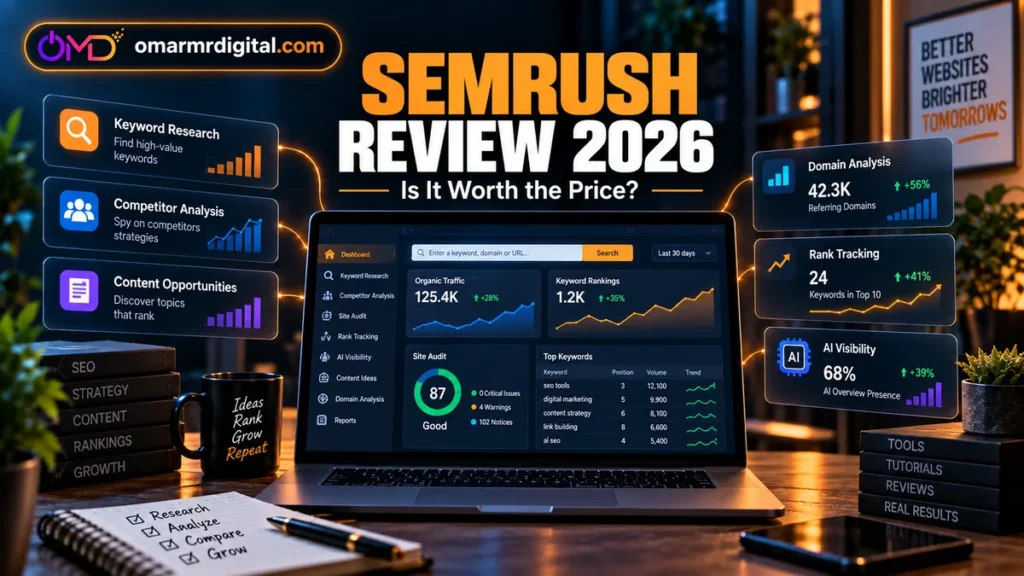
Semrush is one of the most recognizable names in SEO software, but its value in 2026 depends heavily on what you actually need.
For a beginner running one small website, Semrush can feel expensive and feature-heavy. For a freelancer, agency, growing publisher or business that relies on organic search, the platform can replace several separate tools for keyword research, competitor analysis, rank tracking, technical SEO and increasingly AI-search visibility.
This Semrush review 2026 looks at the current platform as it exists now—not the older version many reviews still describe. Semrush has moved toward a more modular structure with SEO, AI visibility, content, advertising, social and other toolkits available separately or in bundles.
- Best for: SEO professionals, growing businesses, agencies, publishers and serious content teams
- Current SEO plan: $139/month or $117.33/month billed annually
- Websites monitored: 5 on the current SEO plan
- Keywords tracked: 500 daily on the current SEO plan
- Strongest areas: Keyword research, competitor analysis, Site Audit, rank tracking and SEO workflow integration
- Biggest drawback: Price and feature complexity for casual users
- Free access: Free entry tier available; most paid toolkits offer a 7-day trial
- 2026 differentiator: Growing integration of traditional SEO with AI-search visibility and prompt tracking
Semrush review 2026: quick overview
| Area | What Semrush offers | Who benefits most |
|---|---|---|
| Keyword research | Keyword Magic Tool, Keyword Overview, Keyword Gap, Keyword Strategy Builder | Bloggers, SEO teams, publishers |
| Competitor research | Organic rankings, domain analysis, keyword gaps, backlink research | Businesses, agencies, niche publishers |
| Technical SEO | Site Audit with issue prioritization and AI-crawler checks | Website owners, SEO teams, developers |
| Rank tracking | Daily keyword tracking, location/device targeting, SERP features | Businesses, agencies, local SEO teams |
| AI search | AI visibility, prompt tracking, brand sentiment and AI-ready audits | Brands adapting to AI discovery |
| Content | Separate Content Toolkit for ideas, briefs and optimization | Content teams and publishers |
| Advertising | Separate Advertising Toolkit | PPC teams and competitive advertisers |
| Social | Separate Social Toolkit | Small teams and social media managers |
Semrush is no longer best understood as one giant subscription that automatically gives every user every marketing tool. In 2026, the platform is increasingly modular: you can start with SEO, add AI visibility, content, social, advertising or other specialist toolkits as your needs grow.
1. Semrush pricing in 2026
The current standard SEO plan costs $139 per month on monthly billing or $117.33 per month when billed annually.
The current SEO plan is positioned for freelancers and small businesses and includes:
- 5 websites to monitor
- 500 keywords tracked daily
- Keyword research and competitor analysis
- Position Tracking
- Site Audit
- AI-search performance tracking
- AI sentiment monitoring
- AI visibility reports
- Custom prompt monitoring
Semrush also offers larger SEO + AI Search tiers. Current annual-billing equivalents are listed at $165.17 per month for Starter, $248.17 for Pro+ and $455.67 for Advanced, with higher website, keyword and AI-tracking limits.
2. Keyword research — one of Semrush’s strongest areas
Keyword research remains one of Semrush’s core strengths. The platform combines several workflows rather than forcing every task into a single keyword box.
Keyword Magic Tool
The Keyword Magic Tool expands a seed topic into large sets of related keyword ideas. You can filter by difficulty, intent, search volume, phrase structure and other criteria to narrow a broad market into realistic content opportunities.
Keyword Overview
Keyword Overview helps evaluate a specific term before you target it. It brings together search demand, competition, intent and SERP context so you can decide whether the keyword belongs in your strategy.
Keyword Gap
Keyword Gap is particularly useful for competitive research. Instead of brainstorming blindly, you compare your domain with competitors and look for relevant topics they rank for but you do not.
Keyword Strategy Builder
Semrush can group keywords into topics and clusters, helping users move from a spreadsheet of disconnected terms toward a more structured content plan.
Semrush currently states that its keyword ecosystem covers more than 28 billion keywords, hundreds of millions of domain profiles and more than 140 regional keyword databases.
Advantages: Large keyword database, intent data, competitive gaps, topic clustering and integrated rank tracking.
Limitations: Beginners can easily collect too much data without a clear content strategy.
3. Competitor analysis
Semrush is particularly valuable when you already know which websites compete with you and want to understand why they receive search traffic.
You can inspect competing domains, identify keywords they rank for, find topics where they outperform you and study visibility changes over time. This is far more actionable than simply knowing that a competitor has “better SEO.”
A useful workflow is to combine competitor research with Keyword Gap: identify missing topics, check the search intent, inspect the actual search results and then decide whether your site can create a genuinely stronger page.
4. Site Audit
Semrush Site Audit crawls a website and groups technical problems that can affect search visibility. The current system covers issues such as crawlability, broken links, schema-related problems and other technical signals.
The tool prioritizes issues by severity and provides explanations to help users understand what needs attention first. Semrush also now checks accessibility for several AI-related crawlers in addition to traditional search-engine crawling.
This makes Site Audit useful for both beginners and professionals. A beginner gets a structured list of problems instead of staring at raw server data, while an experienced SEO can use the reports to prioritize development work.
Advantages: Clear issue grouping, severity prioritization, crawlability checks and AI-crawler visibility checks.
Limitations: A tool can identify a problem, but some fixes still require WordPress, server or development knowledge.
5. Position Tracking
Position Tracking monitors selected keywords over time rather than relying on occasional manual Google searches.
Semrush currently supports daily keyword tracking across locations and devices and can report visibility in SERP features such as featured snippets, video results, local packs and AI Overviews.
The current SEO plan supports up to 500 tracked keywords. That is enough for many small-business and publishing projects, although agencies managing several clients can reach the limit quickly.
6. AI visibility and search in 2026
One of the biggest changes in Semrush is its expansion beyond traditional Google rankings.
The current platform includes AI-search visibility features that monitor how brands appear across systems such as ChatGPT, Gemini, Perplexity and Google AI experiences. Semrush also offers prompt research, brand sentiment analysis and AI visibility reporting.
The basic SEO plan now includes some AI-search performance and sentiment features, while dedicated AI Visibility and combined SEO + AI Search plans increase prompt tracking, daily reports and domain-level monitoring.
For companies that already invest heavily in organic search, this is useful because discovery is no longer limited to ten blue links. However, AI visibility data is still a newer category than traditional rank tracking, so businesses should treat it as an additional signal rather than a replacement for traffic, leads and revenue measurement.
7. Content tools
Semrush now separates many content-production features into its Content Toolkit. The current Base plan is listed at $60 per month when billed annually.
The toolkit includes topic ideas, SEO brief generation, content creation and optimization features. That modular approach can be useful because not every SEO customer needs AI-assisted content production.
It also means buyers should read plan pages carefully. Do not assume every feature you see in Semrush marketing is automatically included in the standard SEO subscription.
8. Is Semrush easy to use?
Semrush has become more organized, but it is still a large professional platform.
A beginner can learn Keyword Overview, Site Audit and Position Tracking fairly quickly. The challenge comes from the number of possible reports, filters, toolkits and metrics available across the wider ecosystem.
The best way to learn Semrush is not to explore every menu. Start with one repeatable workflow:
- Research a topic.
- Find realistic keywords.
- Compare competitors.
- Create or improve a page.
- Track rankings.
- Run periodic Site Audits.
Once that workflow becomes familiar, add more advanced tools only when they solve a specific problem.
9. Limits, extra users and add-ons
One common mistake is comparing Semrush plans only by monthly price. Usage limits can matter just as much.
The current SEO plan includes 5 monitored websites and 500 tracked keywords. Larger tiers raise those limits substantially. Additional users on plans that include the SEO Toolkit currently start at $45 per month.
Specialist toolkits can also increase the total bill. Current examples include:
- AI Visibility from $99/month per domain on annual billing
- Content from $60/month annually
- Social from $20/month annually
- Advertising from $99/month annually
- Local from $30/month
10. Is Semrush good for beginners?
Yes, but that does not automatically mean it is the best first SEO purchase.
A beginner who manages one small site can learn a lot from Semrush, especially Keyword Overview, Site Audit and competitor research. The problem is economic: a $139 monthly subscription can be difficult to justify when you are publishing a few articles and earning little or no revenue from the site yet.
For that user, a lower-cost keyword tool plus Google Search Console and Google Trends may be enough initially.
Semrush becomes easier to justify when you publish consistently, manage multiple projects, perform recurring competitor research or need rank tracking and technical auditing in the same platform.
11. Is Semrush good for small businesses?
For a small business that depends on Google visibility, Semrush can be very useful. The current SEO plan supports five websites, which is enough for many companies operating one main domain plus selected projects or regional properties.
Local service businesses can use it to research service keywords, study competitors, audit their websites, monitor rankings and identify content gaps.
The question is whether someone will actually use the data. Paying for Semrush without a content and SEO workflow is unlikely to create value on its own.
12. Is Semrush good for agencies?
Agencies are one of the clearest Semrush use cases because the platform centralizes research, audits, rank tracking, reporting and competitive analysis across multiple clients.
Higher tiers increase website and keyword limits, while reporting integrations and additional-user options support larger teams.
The cost rises quickly as users, projects and specialist toolkits are added, so agencies should calculate the platform as part of client delivery cost rather than treating it as a generic software expense.
13. Semrush pros and cons
Semrush pros
- Large keyword research ecosystem.
- Strong competitor and keyword-gap analysis.
- Integrated Site Audit and Position Tracking.
- Daily rank tracking on current SEO plans.
- Growing AI-search visibility and prompt-tracking capabilities.
- Useful for managing multiple websites.
- Modular toolkits let businesses add specialist capabilities as needed.
- Free entry tier and trial options make evaluation easier.
Semrush cons
- $139 monthly SEO pricing is expensive for casual users.
- The platform can feel overwhelming to SEO beginners.
- Important specialist capabilities may require separate toolkits.
- Additional users increase monthly cost.
- High limits and advanced reports are unnecessary for very small websites.
- Having more data does not automatically produce a better SEO strategy.
14. Semrush alternatives
Ahrefs
Ahrefs is a natural alternative for users focused heavily on SEO research, links, competitor analysis and keyword data. Its lower-cost Starter plan can also provide a cheaper way to learn the ecosystem before moving to full plans.
Ubersuggest
Ubersuggest is a more affordable option for solo bloggers and small businesses that want keyword research, content ideas, basic competitor analysis and rank tracking without paying Semrush-level pricing.
KWFinder / Mangools
KWFinder is worth considering when your main requirement is straightforward keyword research and SERP analysis rather than a large marketing suite.
LowFruits
LowFruits is useful for publishers specifically interested in long-tail and lower-competition keyword opportunities.
Is Semrush worth it in 2026?
- You publish SEO content consistently.
- You need recurring competitor analysis.
- You manage several websites or clients.
- You want keyword research, audits and rank tracking in one platform.
- You need daily tracking and structured SEO workflows.
- You are beginning to monitor AI-search visibility as well as Google rankings.
- You run one very small website.
- You publish only occasionally.
- Your monthly SEO budget is limited.
- You need only basic keyword ideas.
- You would not use Site Audit, competitor research or rank tracking regularly.
Final verdict
Semrush remains one of the most comprehensive SEO platforms available in 2026, but its value comes from using several parts of the workflow together.
Keyword research alone probably does not justify the subscription for a small beginner site. Keyword research combined with competitor analysis, Site Audit, Position Tracking and ongoing content planning is a much stronger case.
The platform is also evolving in an important direction: traditional SEO data is increasingly connected with AI-search visibility, prompt monitoring and brand presence across answer engines.
For serious publishers, agencies, freelancers and businesses where organic visibility contributes directly to revenue, Semrush can justify its price. For casual bloggers and early-stage websites, lower-cost tools may deliver enough value until the site grows.
Frequently asked questions
How much does Semrush cost in 2026?
The current standard SEO plan is listed at $139 per month or $117.33 per month when billed annually. Higher SEO + AI Search plans increase limits and AI visibility features.
Does Semrush have a free plan?
Yes. Semrush currently offers a free entry tier, and most paid toolkits offer a 7-day trial so users can evaluate the platform before subscribing.
Is Semrush worth it for beginners?
It can be, but the price is difficult to justify if you manage only one small site and publish infrequently. Beginners who will actively use keyword research, Site Audit, rank tracking and competitor analysis can get much more value from it.
Is Semrush good for keyword research?
Yes. Keyword research is one of Semrush’s strongest areas. The platform includes Keyword Magic Tool, Keyword Overview, Keyword Gap and Keyword Strategy Builder, plus integration with rank tracking and competitor research.
Does Semrush track rankings daily?
Yes. Current Position Tracking supports daily keyword monitoring, with plan limits determining how many keywords and projects you can track.
Can Semrush audit a WordPress site?
Yes. Site Audit crawls websites regardless of whether they use WordPress, another CMS or a custom platform. It reports technical issues that may affect crawlability and visibility.
Does Semrush track AI search?
Yes. The current platform includes AI-search visibility reporting, prompt tracking and brand sentiment features, with larger limits available through dedicated AI Visibility and combined SEO + AI Search plans.
Is Semrush better than Ahrefs?
They overlap heavily but emphasize different workflows and interfaces. Semrush combines SEO with a broader modular marketing ecosystem, while Ahrefs is especially strong as an SEO research platform. The better fit depends on which tools your workflow uses most.
Can Semrush replace Google Search Console?
No. Google Search Console provides first-party information about how your own site appears in Google Search. Semrush adds third-party research, competitor data, rank tracking and auditing. The two are more useful together than as substitutes.
Who should use Semrush?
Semrush is best suited to businesses, publishers, freelancers and agencies that perform SEO regularly and need research, auditing, tracking and competitive intelligence in a shared platform.
Last reviewed: September 19, 2026. Semrush pricing, plan names, usage limits, trials and toolkit features can change. Always verify current terms on the official Semrush website before subscribing.